
Most conversations about Bahrain's import economy default to a few familiar headlines — oil, aluminium, gold. But look past the headline numbers and into the actual commodity data, and a different picture emerges: Bahrain's day-to-day supply chain runs on a much wider mix of goods than most people assume, and Saudi Arabia — connected directly by the King Fahd Causeway — is at the center of it. We went through the official trade data to see what's actually crossing the causeway in volume. Here's what stood out.
Construction Is the Backbone
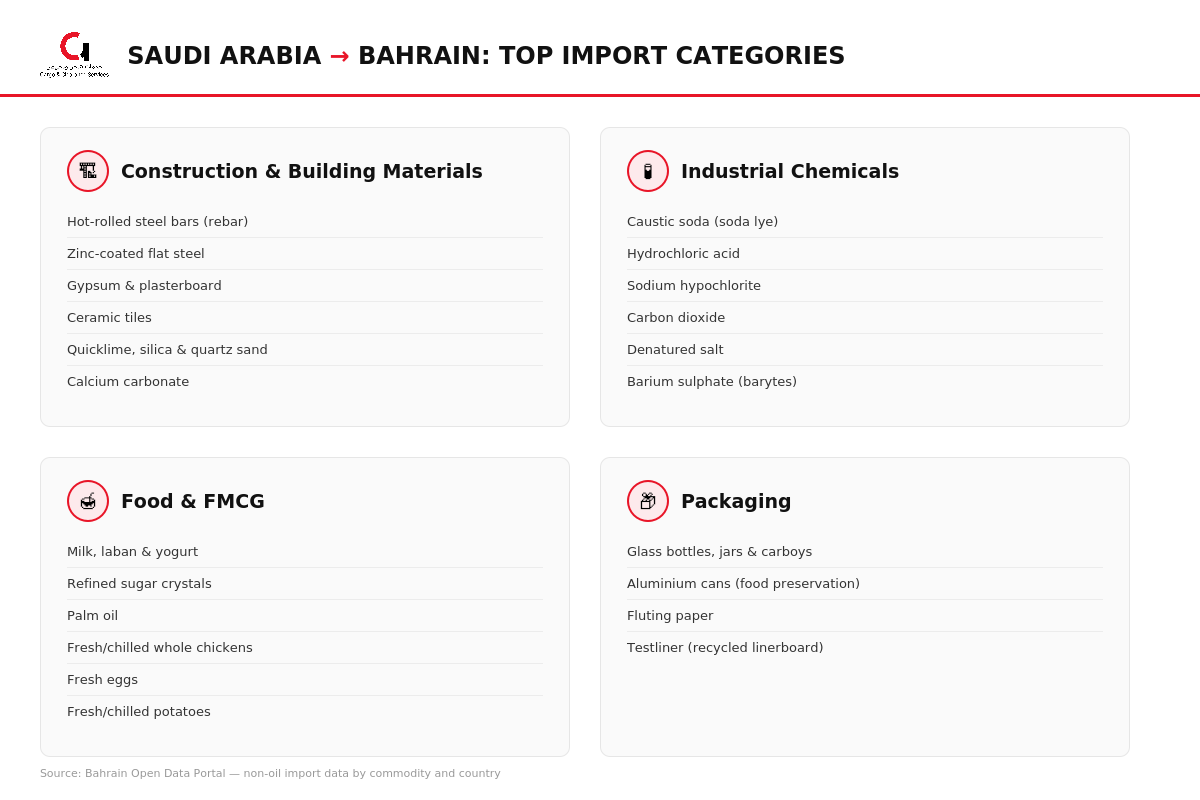
By far the largest cluster of high-volume goods moving from Saudi Arabia into Bahrain is construction and building materials: quicklime, silica and quartz sand, calcium carbonate, gypsum, plasterboard, ceramic tiles, hot-rolled steel bars, and zinc-coated flat steel. This isn't surprising given the pace of development across the Gulf, but it does say something important for anyone in the building materials trade: this is a recurring, high-frequency lane, not a one-off shipment category. Steel rebar and plasterboard in particular show up as consistent, high-volume lines — exactly the kind of cargo that benefits from a dependable, repeat-use logistics partner rather than a one-time broker.
An Overlooked Category: Industrial Chemicals
One of the more surprising findings was the volume of industrial chemicals moving across the causeway — caustic soda, hydrochloric acid, sodium hypochlorite, carbon dioxide, and denatured salt among them.
Several of these are core inputs for water treatment and industrial processing, which points to a steady, unglamorous but essential trade lane that rarely gets discussed publicly. If your business handles chemical cargo, it's worth knowing this lane is both active and requires a logistics partner who understands the compliance and handling requirements that come with it.
Dairy, Food, and FMCG Keep Moving Daily
Milk, laban, yogurt, refined sugar, palm oil, fresh chicken, fresh eggs, and potatoes all appear among the highest-volume lines. This reflects something anyone in the food trade already knows intuitively: fresh and short-shelf-life goods depend on fast, reliable, temperature-appropriate freight far more than they depend on the cheapest rate on paper. A delay that would be a minor inconvenience for construction materials can mean a written-off shipment for fresh dairy or poultry.
Packaging: The Category Hiding in Plain Sight
Glass containers — bottles, jars, carboys — along with aluminum cans for food preservation and paper products like fluting paper and testliner, all show up as high-volume lines. Packaging rarely gets discussed as its own category, but it's a genuine, steady trade lane in its own right, tied closely to the food and consumer goods industries it serves.
Why This Matters
None of this is exotic. It's the unglamorous, high-frequency cargo that keeps a modern economy running — and it's exactly the kind of trade that benefits most from a logistics partner who treats the Saudi-Bahrain corridor as a core lane rather than an afterthought. Whether you're moving steel, chemicals, food products, or packaging materials across the causeway, the fundamentals are the same: consistency, compliance, and a partner who understands what's actually in the truck.
Let's Talk About Your Lane
If your business ships any of the categories above — or something entirely different — between Saudi Arabia and Bahrain, we'd like to hear about it.
Source: Bahrain Open Data Portal, non-oil import data by commodity and country.